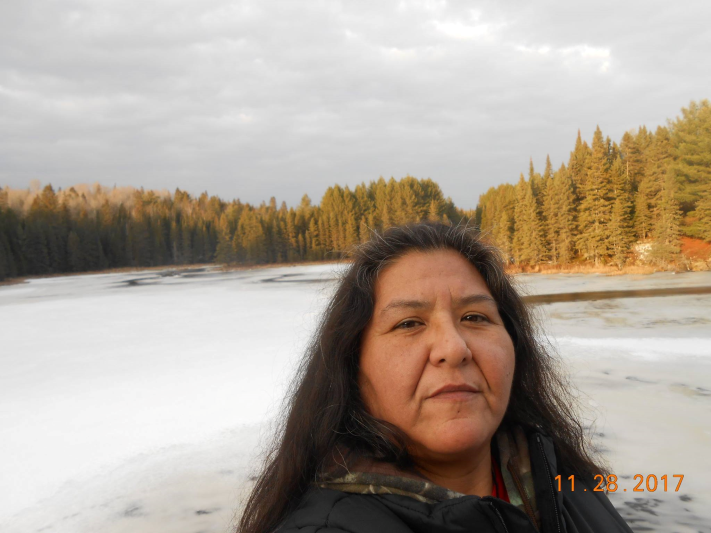
For Aboriginal peoples, culture and identity are based on our spiritual relationship to the land and the pursuit of traditional harvesting activities in all areas of traditional use, including hunting, trapping, fishing and gathering.
Aboriginal and Treaty Rights are recognized in the Canadian Constitution and in legal decisions involving natural resources use, and should be given contemporary interpretation. Our land ethics are not well understood by many governmental natural resource managers.
This land ethic includes four belief areas: All Is Sacred, Right Action, All Is Interrelated and Mother Earth. Beliefs concerning the environment spring from a spiritual context rather than the scientific‐utilitarian context more prevalent in the dominant Euro‐American culture.
Because of our unique relationship with the land, Aboriginal peoples have developed special knowledge of forest ecosystems, knowledge which may be shared and used in improving forest management practices. Aboriginal peoples have a right to share in the economic development afforded others by forestry activities. Aboriginal peoples are not just another forest “stakeholder”.
The study of Forestry also encompasses the study of ecology, conservation biology, environmental and natural science, political science, economics, engineering, management, sustainable development, geography, urban forestry, planning, psychology and public health.
Traditional Forest Use of the Chippewas of Georgina Island [PDF/292KB] — Article written by Heather Charles for The Ontario Woodlander
CGIFN works with Silv-Econ Ltd. resource management consultants for forestry management.
Past Studies
Species at Risk: Ash Tree
Our ash tree population is at risk from the invasive Emerald Ash Borer (EAB), which is native to Asia. The EAB lays its eggs in the cracks of ash tree bark; larvae then bore underneath and feed on the cambium. Eventually they girdle the ash tree, cutting off the flow of water and nutrients and killing it.
While the EAB can fly up to several kilometres, significant factors contribute to its spread such as the movement of firewood, nursery stock, trees, logs, lumber, wood with bark attached, wood/bark chips and pallets (unless kiln dried).
Signs of infestation include: a thinning crown, diminished density of leaves, epicormic shoots growing from the trunk or branches, evidence of adult beetles feeding on leaves, vertical cracks in trunks, small D-shaped exit holes, S-shaped tunnels under the bark filled with fine sawdust, and woodpecker feeding.
If you think you have seen this invasive species, please contact GIFN as soon as possible at 705-437-1337. Due to the EAB being identified in the Newmarket area, absolutely no firewood is to be transported to the First Nation without proof of local purchase.
2017 Ash Tree Survey – Snake Island
Identification & Management Resources
- Identifying Ash Trees & EAB Infestations [PDF/315KB]
- About the EAB – forestinvasives.com
- A visual guide to detecting emerald ash borer damage [PDF/1.2MB] (Natural Resources Canada)
- Emerald ash borer: a guide to identification and comparison to similar species [PDF/5.4MB] (Michigan State University)
- Video: Emerald Ash Borer Beetle
- Video: The Lifecycle of the EAB
- Woodlot Management for EAB [PDF/7.9MB] (Ontario Ministry of Natural Resources)
- Survey guide for detection of emerald ash borer (Natural Resources Canada/Canadian Food Inspection Agency)
Heather Charles - Ash Tree Monitoring & Management Coordinator
Heather Charles is a member of the Chippewas of Georgina Island First Nation. Her spirit name is Giiwadonnongose Kwe (North Star Woman) and she is of the Wolf Clan. Her diverse employment experiences include: Chainsaw Operator, Emergency First Response Coordinator, Education Assistant for the York Region District School Board, Day Care Cook, Construction Labourer, Women’s Advocate/Native Outreach Worker/Volunteer Coordinator at a local Women & Children’s Shelter, Union Representative, VP of the Anti-Oppression/Anti-Racism Committee for Ontario Association for Interval and Transition Housing. Some other things you may not know:
- Heather is also an experienced faster (4 days/nights and 2 days/nights)
- A Talking Circle facilitator, powwow dancer (1st place for Women’s Traditional “back in the day”)
- A commissioned artist and published author.